 Clausey
AI-native firms don't pull ahead because they have better models. Everyone rents the same models. They pull ahead because a handful of structural choices compound — how many tools they run, whether they own their software, who makes decisions, how cheap an experiment is, and who keeps the savings when AI cuts the cost of the work. Investors have made the case for the multiple. This is the operator's view of the mechanisms underneath it.
Seven of them, in plain English and faithful to the deck below. Most are structural rather than technical, which is what makes them hard to copy: an incumbent can see every one of these and still not be able to adopt it without rebuilding how the firm runs.
What does 5x actually measure?
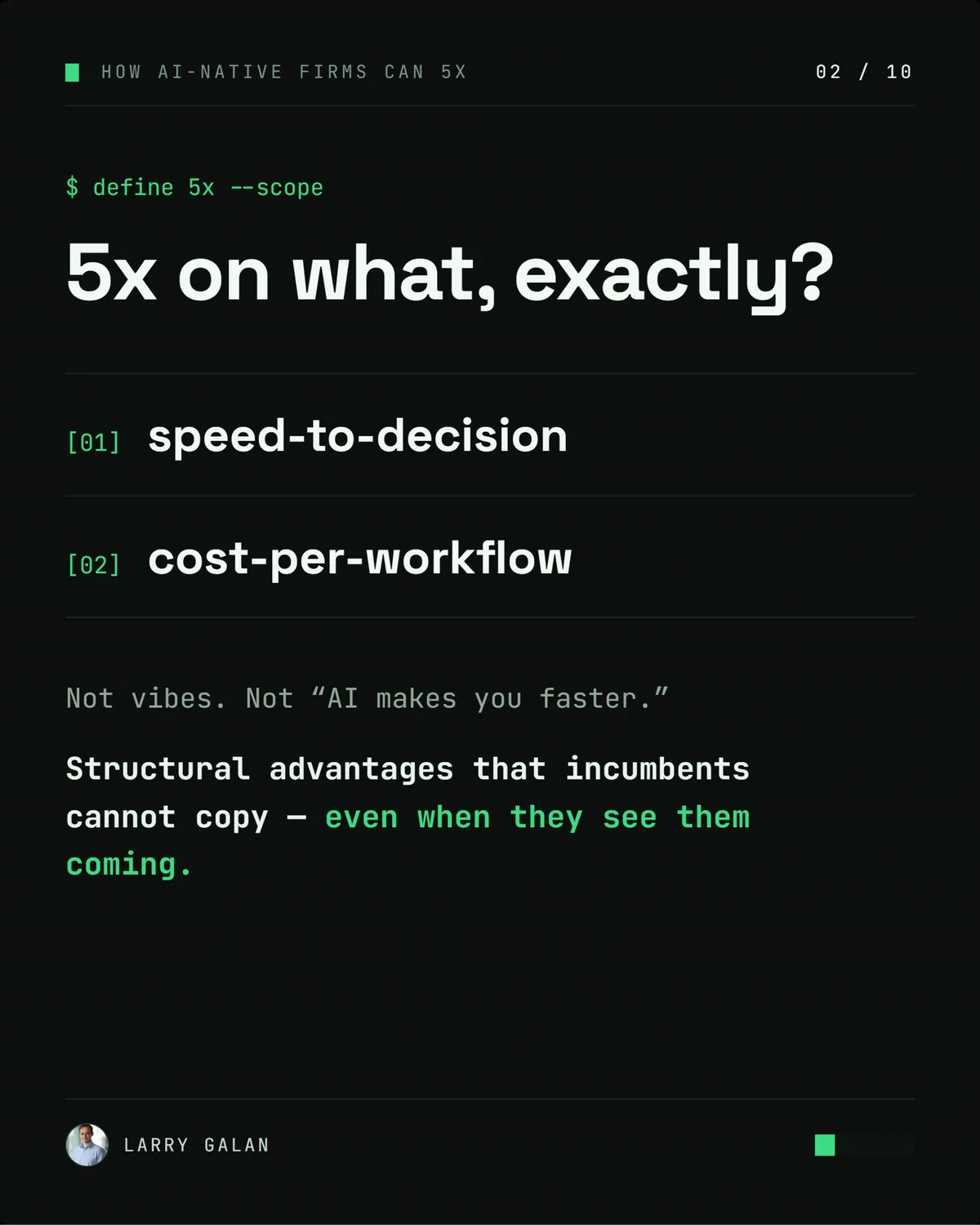
Two things, and neither of them is vibes. The first is speed-to-decision: how long it takes the firm to go from a question to a committed answer. The second is cost-per-workflow: what it costs to run one unit of real work end to end.
Both are measurable, and both are downstream of structure rather than effort. That matters, because "AI makes you faster" is not a strategy — it is a hope. What follows are the specific arrangements that move those two numbers.
1. No tool bloat
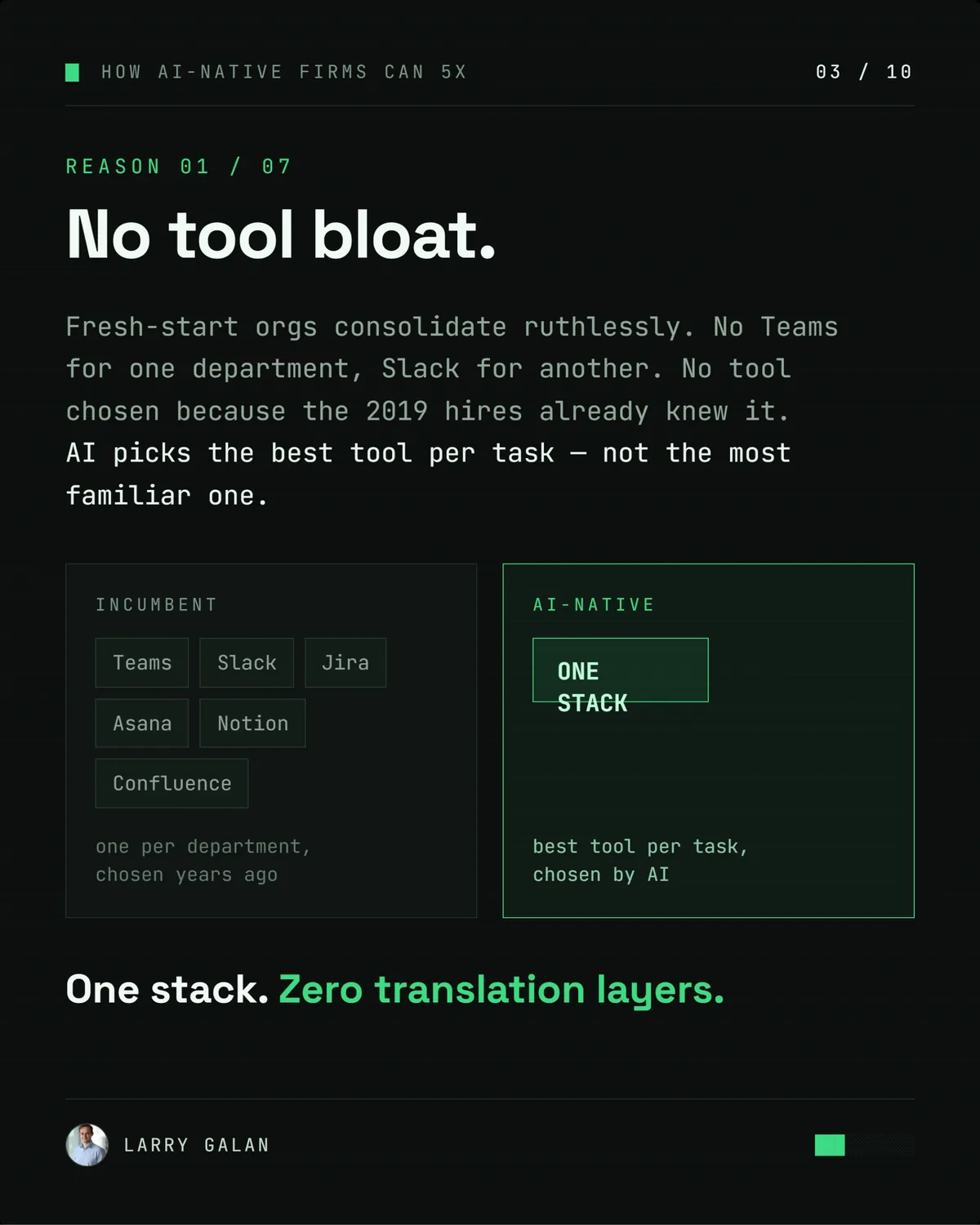
Firms that start fresh consolidate ruthlessly. There is no Teams for one department and Slack for another, no tool chosen because the 2019 hires already knew it, no integration layer stitching together decisions nobody remembers making.
The AI-native version picks the best tool per task rather than the most familiar one, because the cost of learning a new tool collapses when the model does the learning. One stack, zero translation layers — and every hour not spent moving data between systems is an hour of actual work.
2. Open source plus AI equals ownership
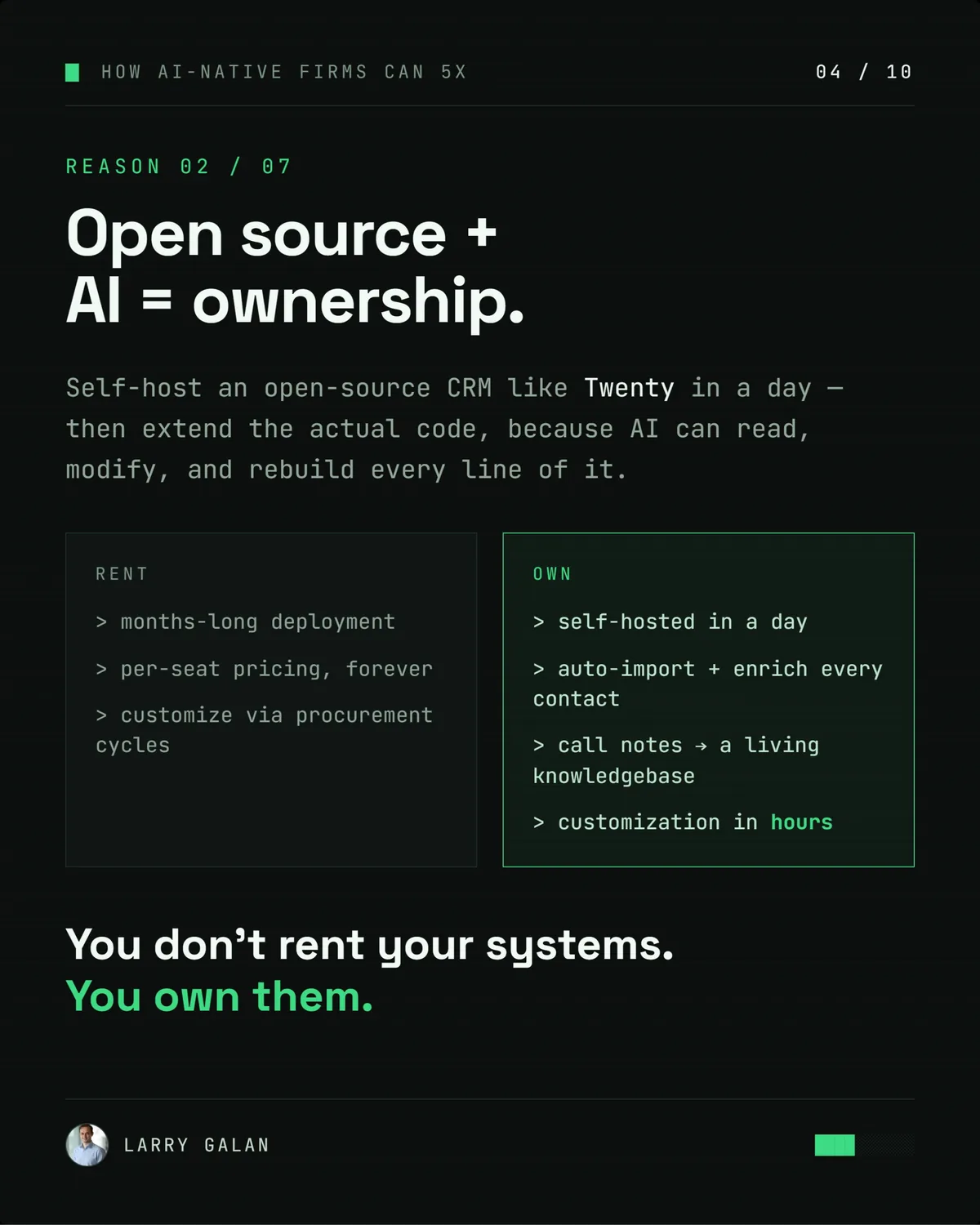
This one changes what "buy versus build" means. You can self-host an open-source CRM like Twenty in a day, and then extend the actual source, because a model can read, modify, and rebuild every line of it.
Compare the two paths honestly. Renting means a months-long deployment, per-seat pricing forever, and customization that runs through a procurement cycle. Owning means self-hosted in a day, contacts auto-imported and enriched, call notes accumulating into a living knowledge base, and customization measured in hours. The difference is not cost. It is that you stop renting your systems and start owning them.
3. The bottleneck was never headcount
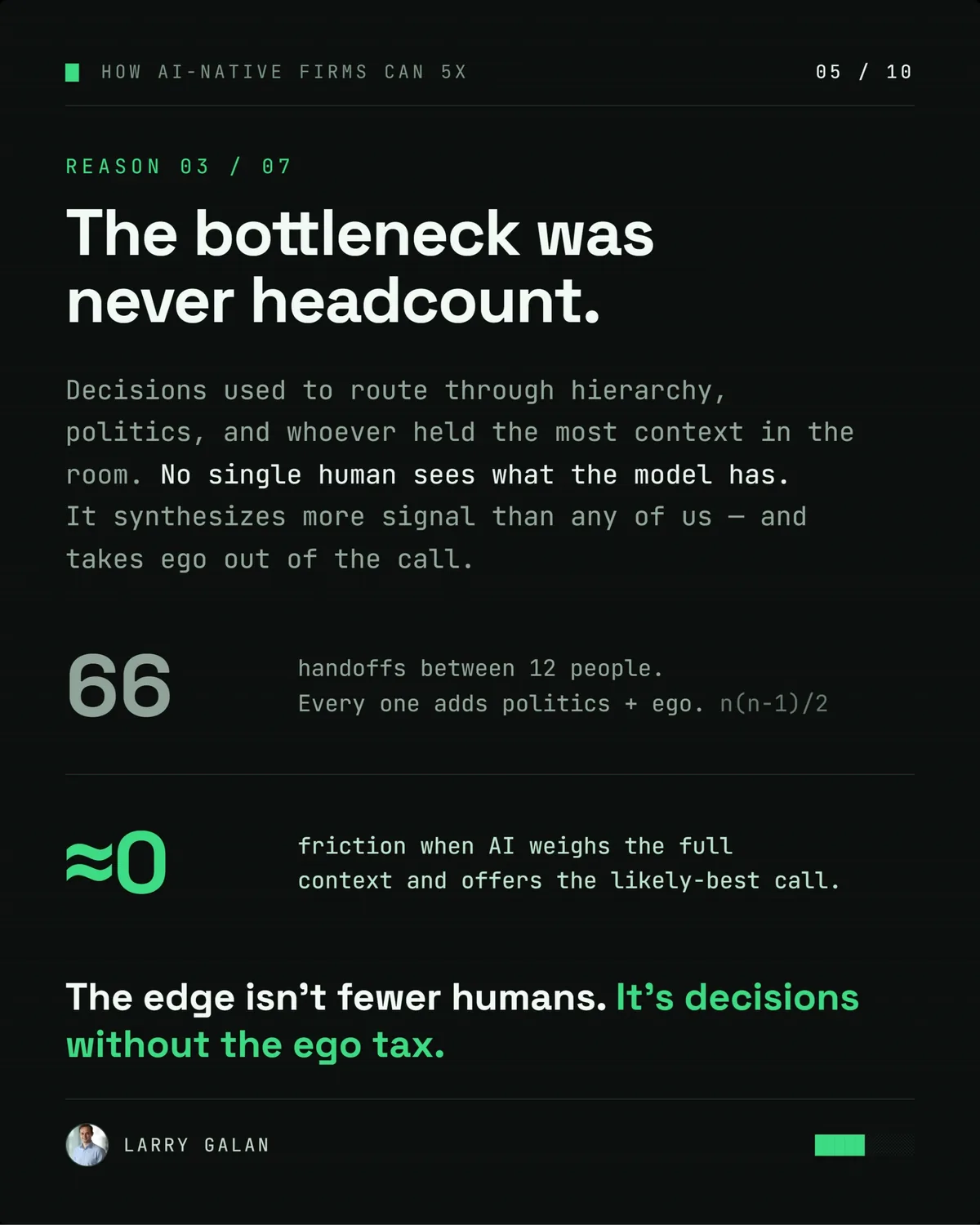
Decisions used to route through hierarchy, politics, and whoever happened to hold the most context in the room. That last part is the real constraint, and it is worth being precise about the arithmetic: coordinating twelve people means sixty-six possible handoffs, because n(n−1)/2 grows quadratically. Every one of those handoffs adds latency, politics, and ego.
A model does not have that problem. No single human sees what it sees — it synthesizes more signal than any individual in the room, and it has no stake in whose idea wins. The edge is not fewer humans. It is decisions without the ego tax.
4. Software becomes disposable
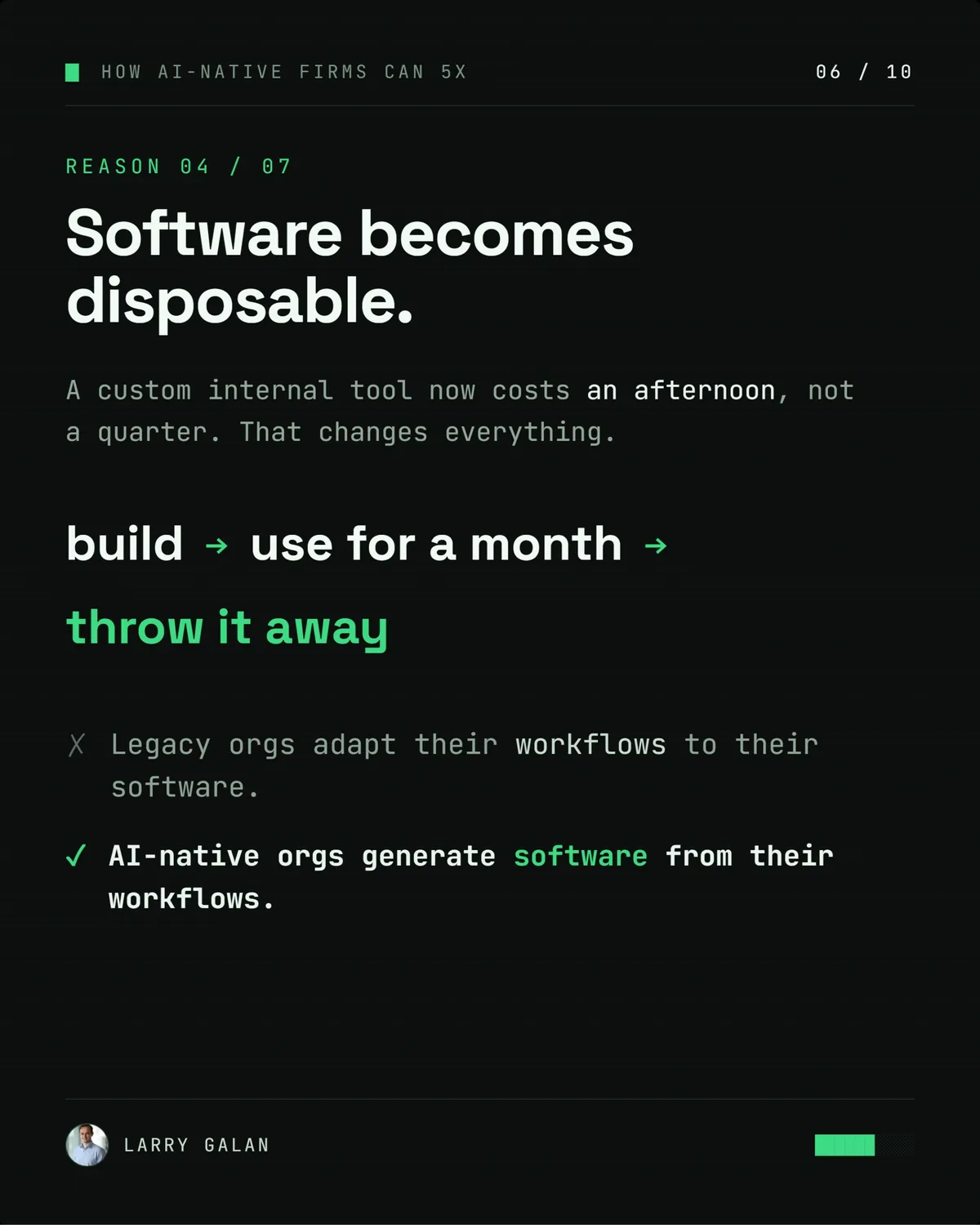
A custom internal tool used to cost a quarter. It now costs an afternoon, and that single change in price rewrites what software is for.
When building is expensive, you build carefully and then live with it for years, adapting your workflow to the tool. When building is nearly free, the honest lifecycle is build it, use it for a month, throw it away. Legacy organizations adapt their workflows to their software. AI-native organizations generate software from their workflows — which means the process never has to bend to accommodate a tool that was right two years ago.
5. Process debt outweighs tech debt
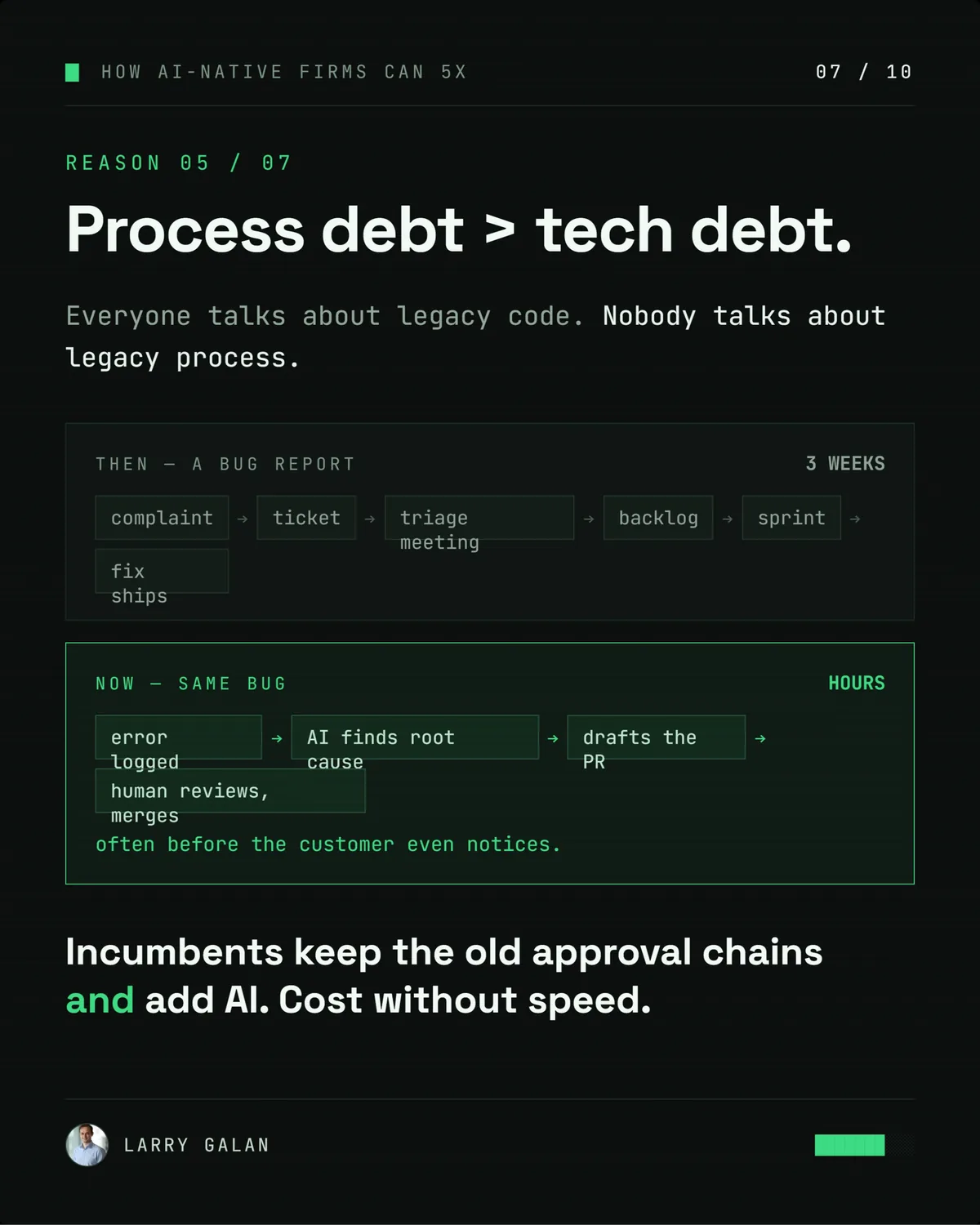
Everyone talks about legacy code. Almost nobody talks about legacy process, and it is the more expensive of the two.
Take an ordinary bug. The old path: a complaint becomes a ticket, the ticket waits for a triage meeting, triage sends it to a backlog, the backlog feeds a sprint, and the fix ships about three weeks later. The AI-native path: the error is logged, a model finds the root cause and drafts the pull request, a human reviews and merges. Hours, and often before the customer notices anything went wrong.
Here is the trap, and it is the most common failure I see: incumbents keep every link in the old approval chain and add AI on top. That buys cost without speed. The chain was the latency all along.
6. The experimentation ratio
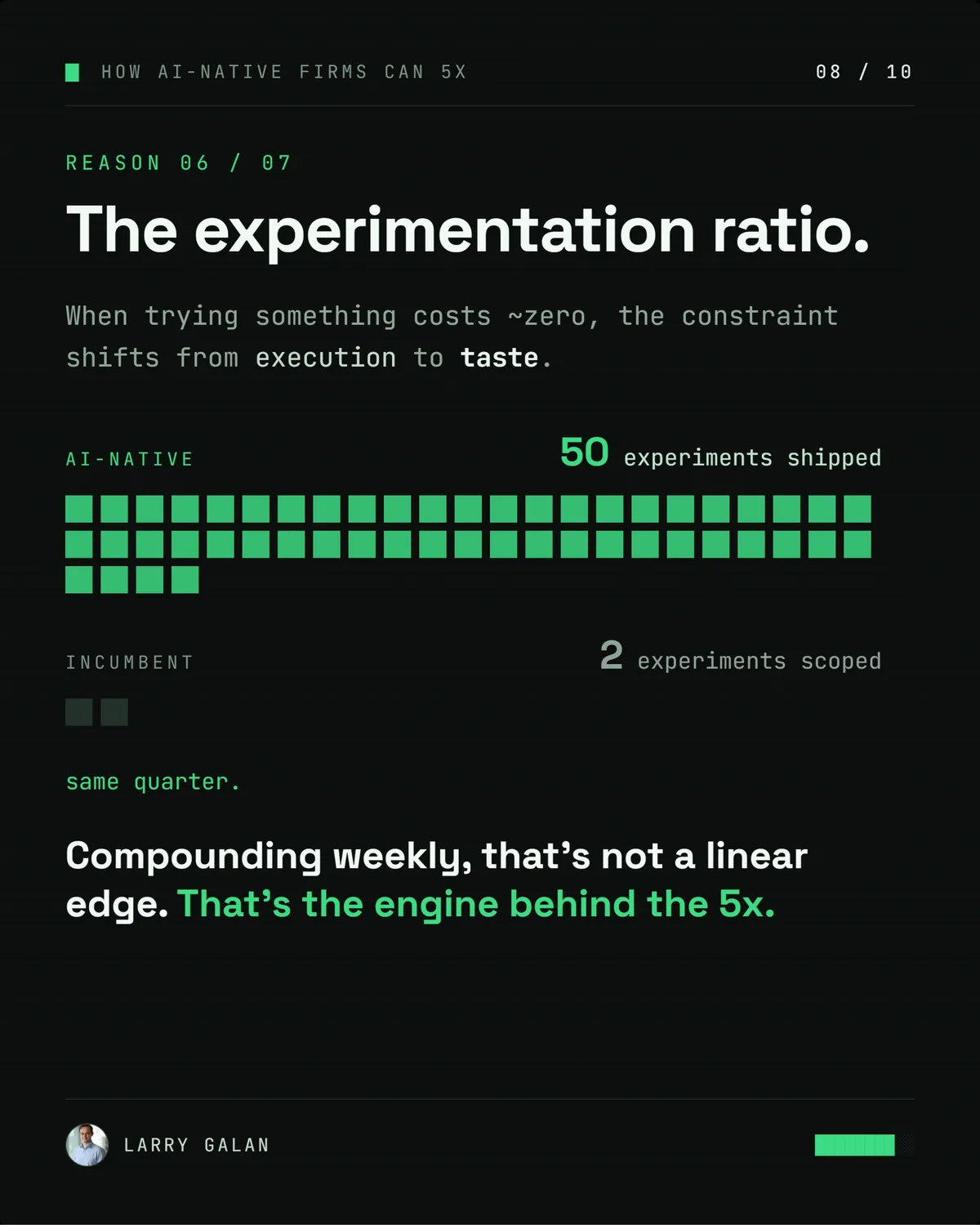
When trying something costs approximately zero, the binding constraint stops being execution and becomes taste — knowing which things are worth trying at all.
The gap this opens is not subtle. In the same quarter, an AI-native team can ship dozens of experiments while an incumbent is still scoping two. And because the learning from each one feeds the next, the advantage compounds weekly rather than adding up linearly. That compounding is the actual engine behind the multiple.
7. Who keeps the AI savings?
This is the mechanism most firms never think about, and it decides whether any of the others show up in your margin.
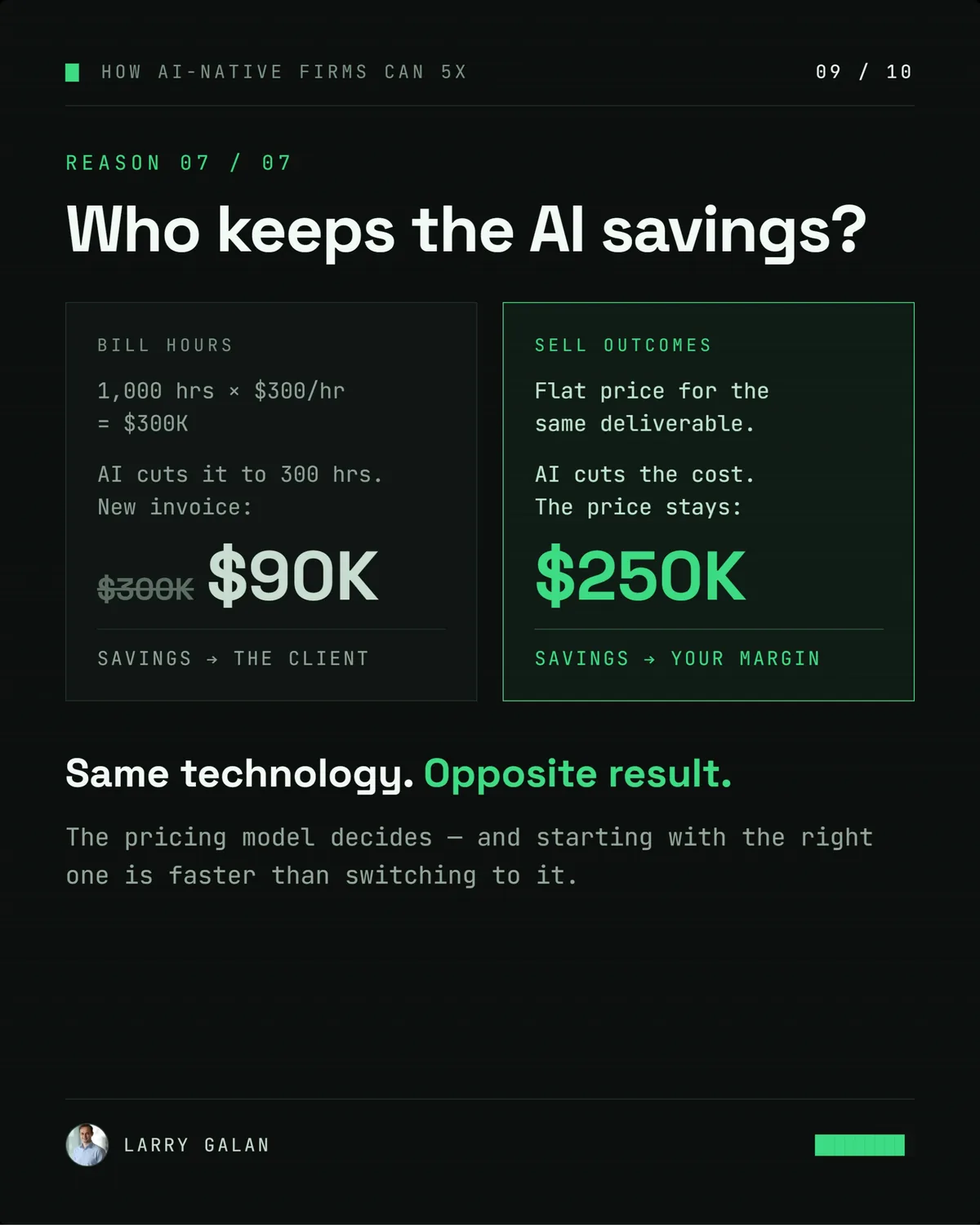
Suppose a deliverable takes a thousand hours at three hundred dollars an hour. If you bill by the hour and AI cuts the work to three hundred hours, your invoice falls to ninety thousand dollars. The efficiency is real — and every dollar of it goes to your client. If instead you sell the outcome at a flat price, AI cuts your cost and the price holds. Same technology, opposite result.
Neither is wrong, and billing hours is not dishonest. But the pricing model decides who captures the gain, and starting with the right one is considerably faster than switching to it after your rate card has trained your clients to expect hours.
Seven that compound
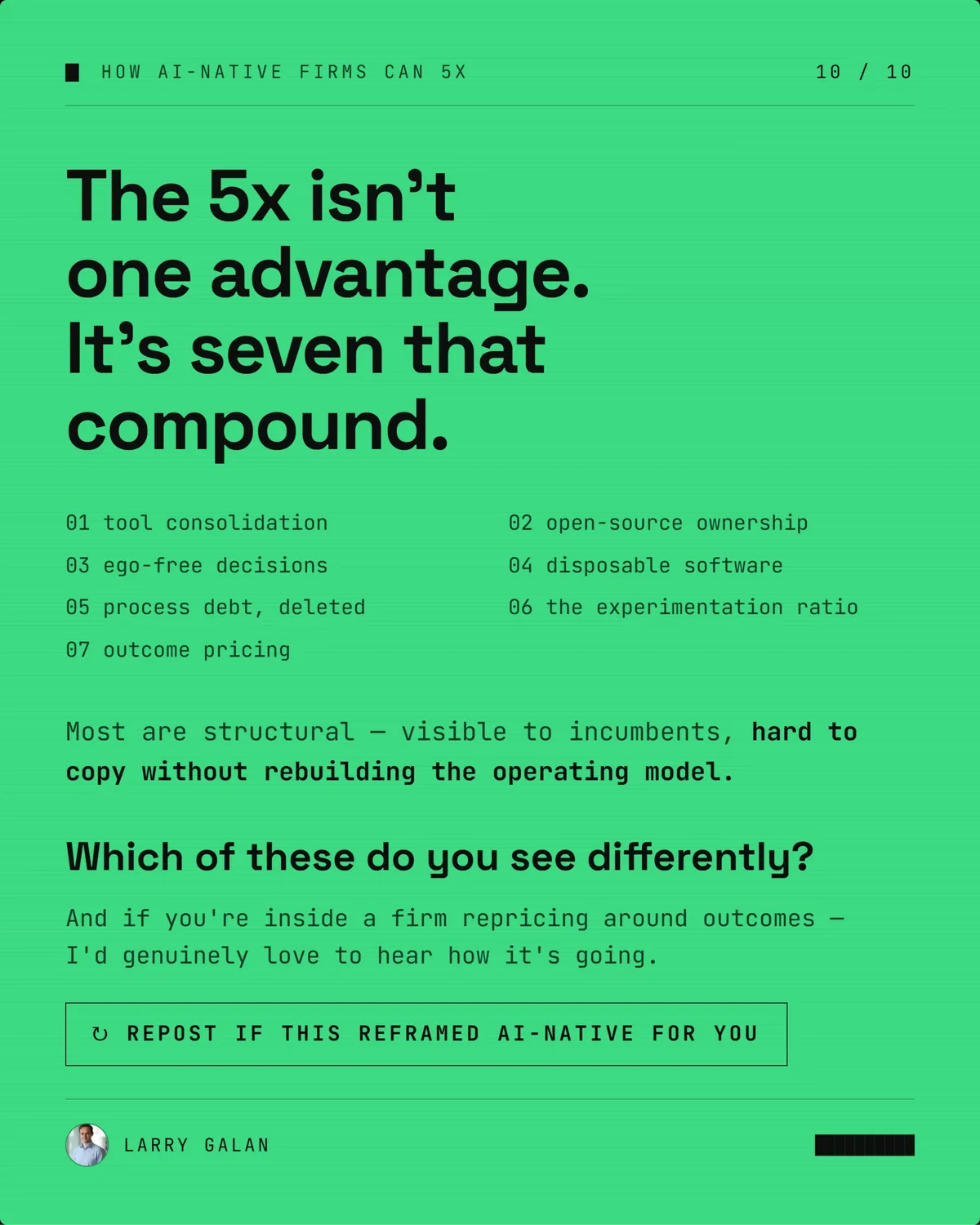
The 5x is not one advantage. It is tool consolidation, open-source ownership, ego-free decisions, disposable software, deleted process debt, the experimentation ratio, and outcome pricing — stacked, each making the next one cheaper.
What makes them durable is that most are structural rather than technical. An incumbent can read this list, agree with all of it, and still not be able to act on it, because adopting any one properly means rebuilding the operating model around it. Buying the same models changes nothing. That is the whole point.
Where Clausey fits
We build this way, which is the only reason I can describe it. Clausey is a small team running one consolidated stack, generating internal tools we fully expect to discard, and shipping on the loop described in our engineering playbook.
It is also what we sell. Clausey reads your contracts, records, and policies and answers with citations, so the decision-making bottleneck in mechanism three — no single human holding enough context — stops being your constraint too.